Sub-Two: The Anatomy of a 117-Year Pursuit
May 3, 2026
Last Sunday in London was marvelous for endurance athletics fanatics.
Sabastian Sawe ran 1:59:30 at the London Marathon, registering the first official, record-eligible sub-two-hour marathon in history.
For many, the sub-2 performance is in the same class as the sub-4-minute mile threshold: a clean, round-number barrier that was once thought impossible, then suddenly became real.
Sawe's time is also just 92 seconds shy of Michael Joyner's famous 1991 physiological model mark of 1:57:58 for the marathon. In other words, at least by one framework, the two-hour barrier was not the absolute limit. There may still be room to run.
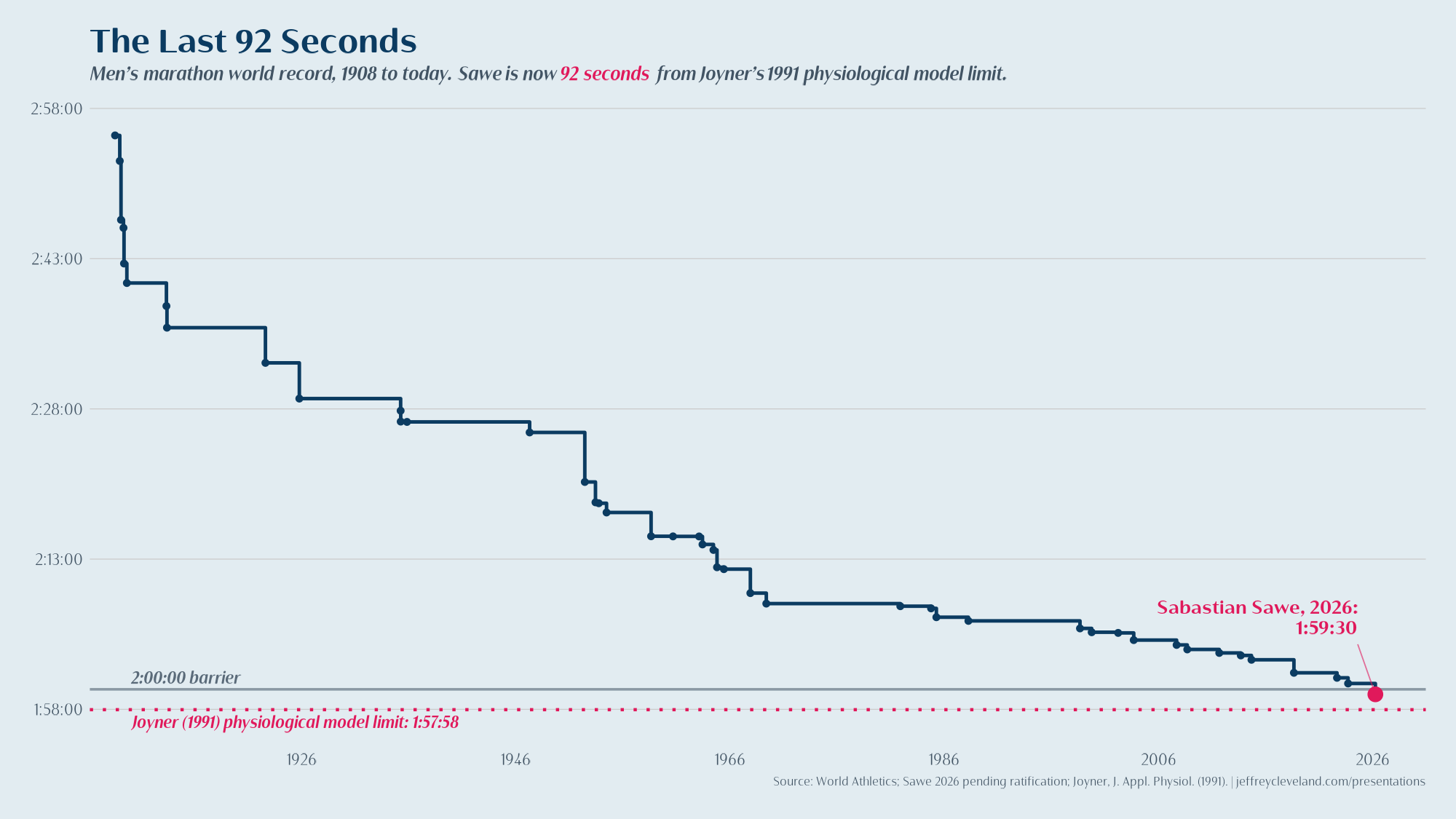
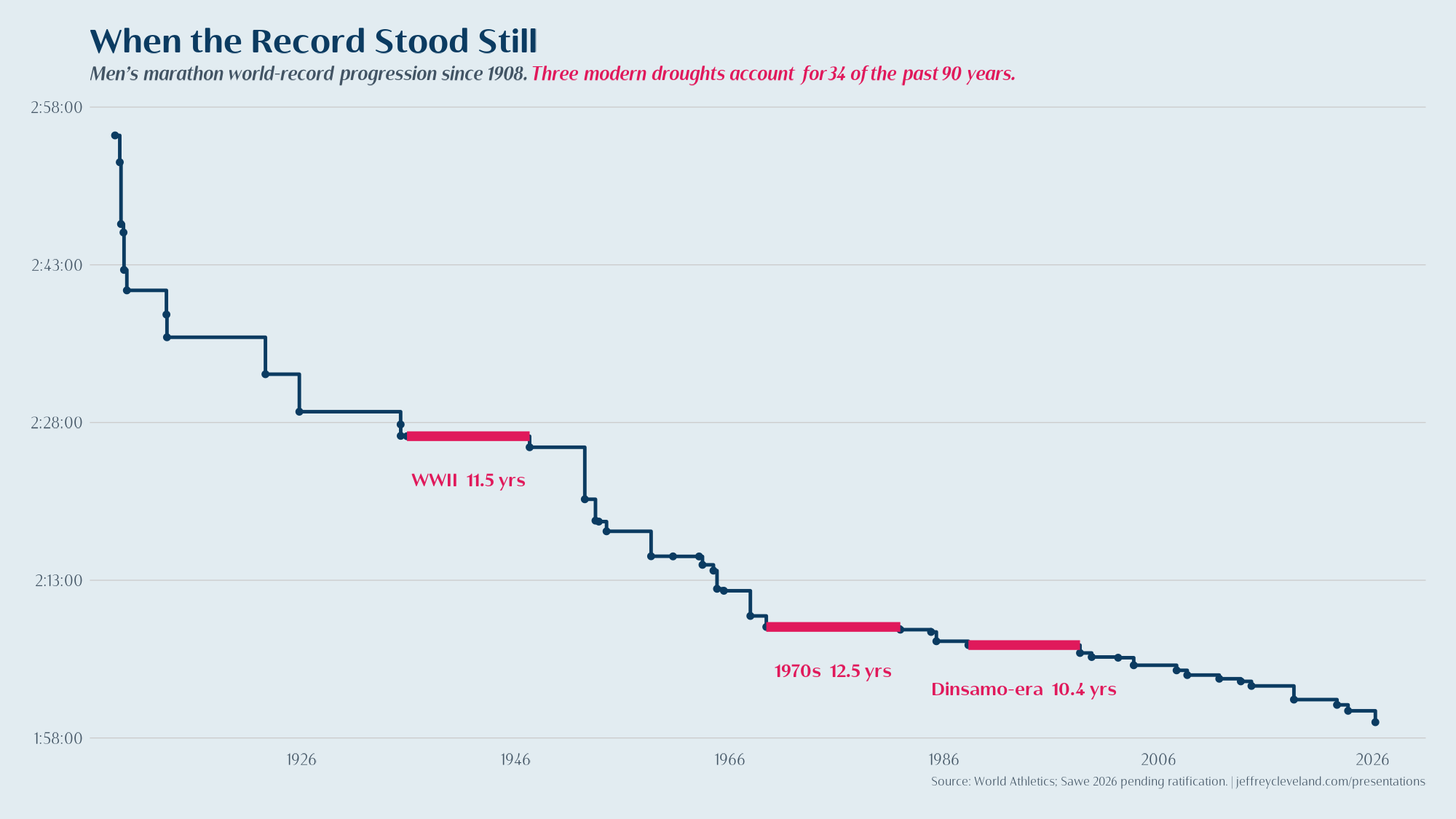
Marathon records are interesting: they come in bursts, sometimes followed by long plateaus, often with years between record-breaking performances.
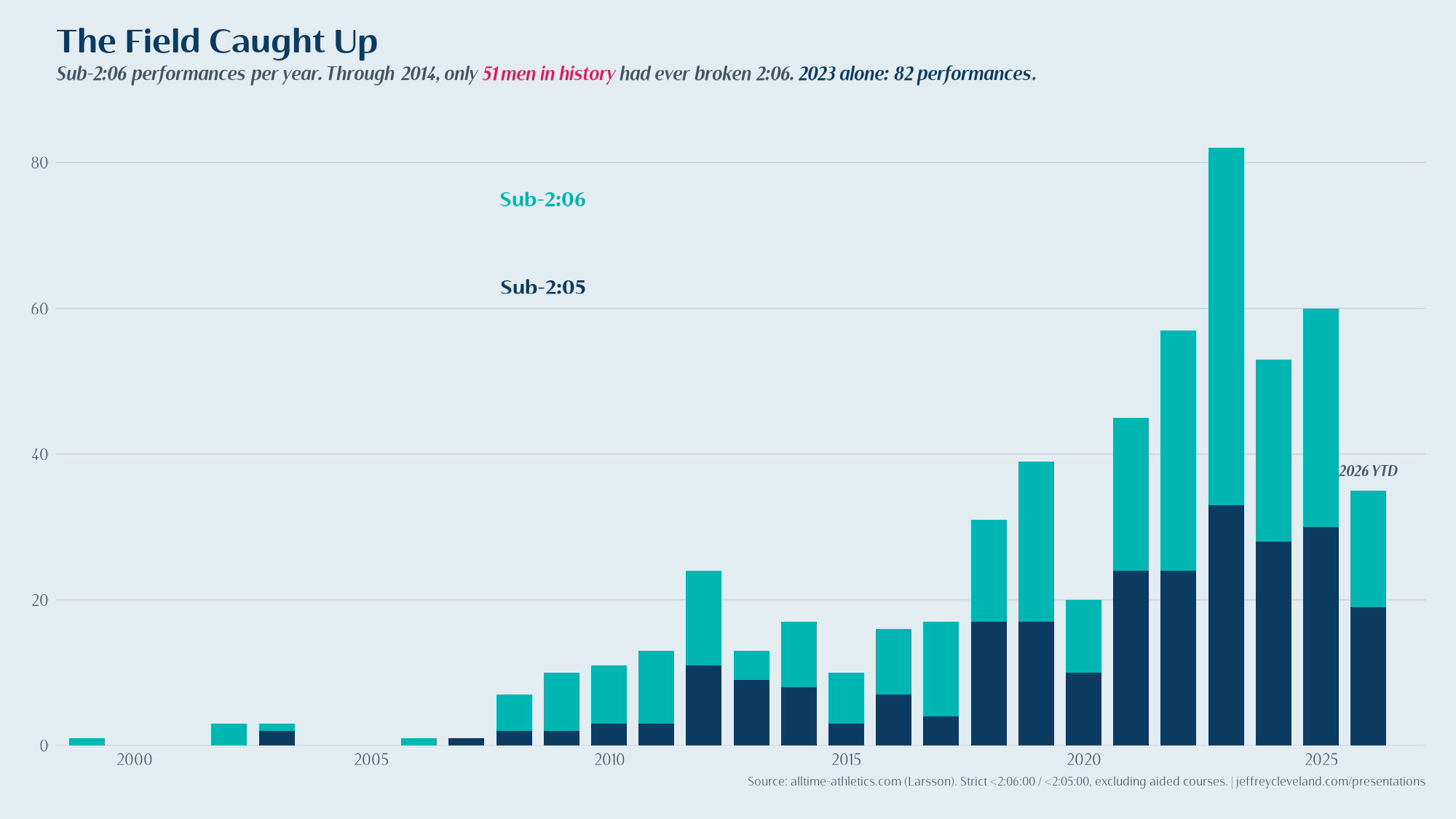
But beyond the record-breaking performances, we've also seen a flood of runners running fast. In 1999, only one man broke 2:06. By 2014, only 51 men had ever broken 2:06. But in 2023 alone, we saw 82 sub-2:06 performances. In 2026, year-to-date, we've already seen 35 sub-2:06 runs!
And this depth showed up at the very top in London, too. Yomif Kejelcha also broke the two-hour barrier (in his marathon debut, no less!), while Jacob Kiplimo finished third in 2:00:28, a time that was also under the previous world record.
So what's changed?
Super shoes get a lot of attention, but they don't just help on race day: they enable better training, more high-volume work, and better recovery throughout the marathon build.
But another key innovation: fueling, or the ability to chug down more than 100 grams of carbohydrates an hour while running at elite marathon pace.
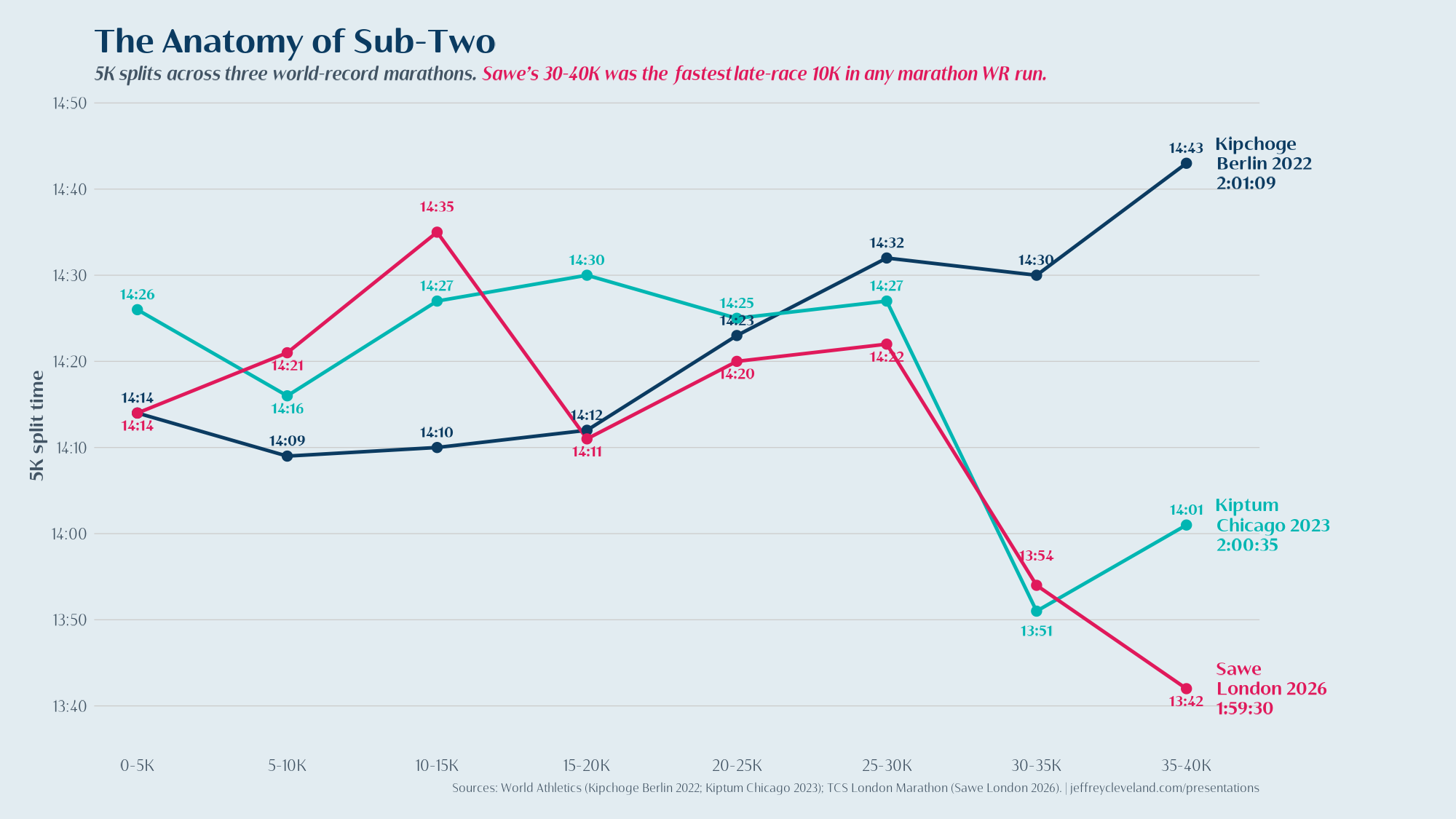
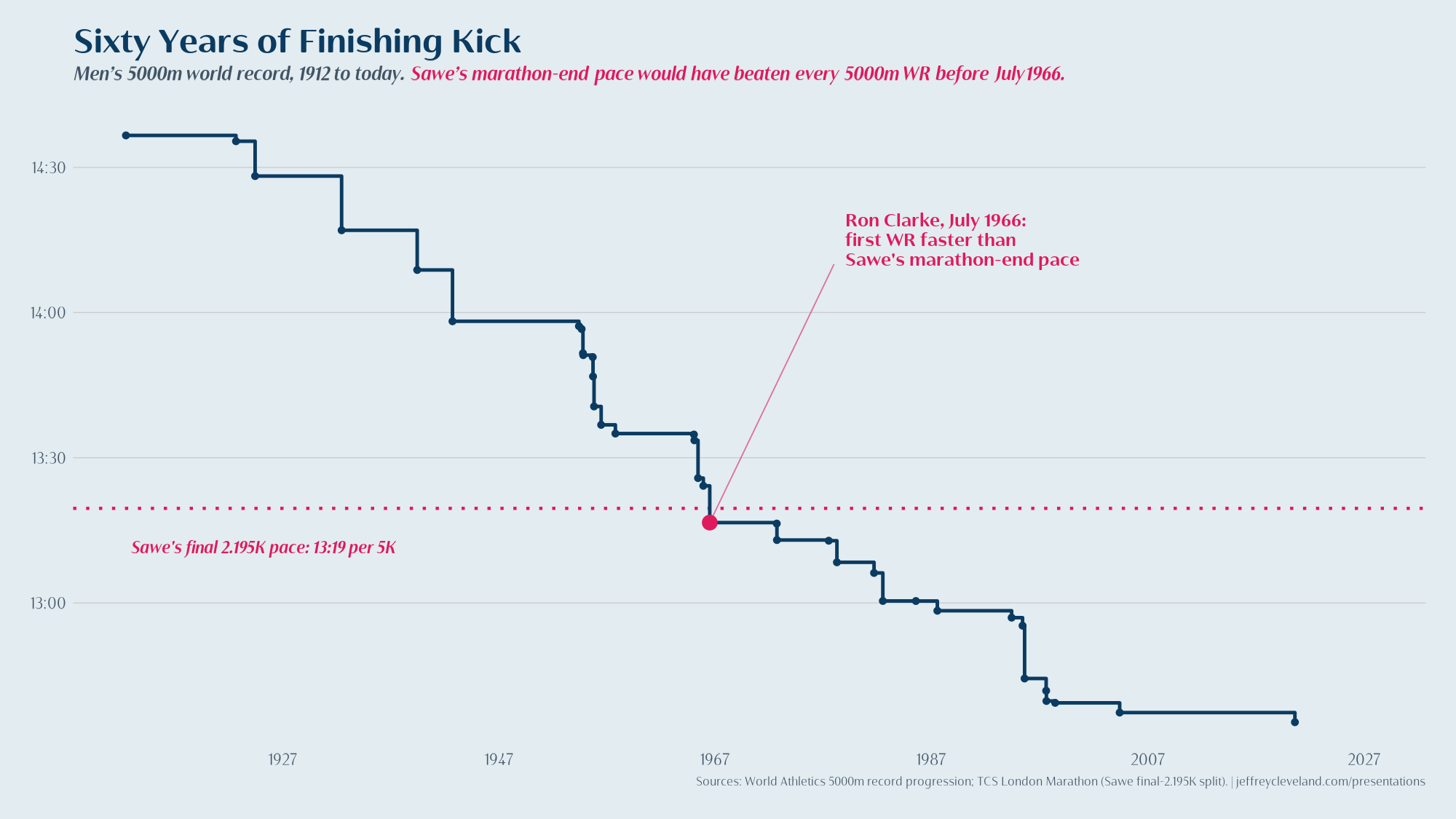
And as proof of how scalable these drivers are, look at how Sawe did it: negative-splitting the race, running 5K splits of 13:54 and 13:42 from 30K to 40K. His final 2.195K closing pace was 5000m world-record pace circa 1966. Among marathon world-record runs, no one has ever closed faster.
Will the first official sub-two open the floodgates?
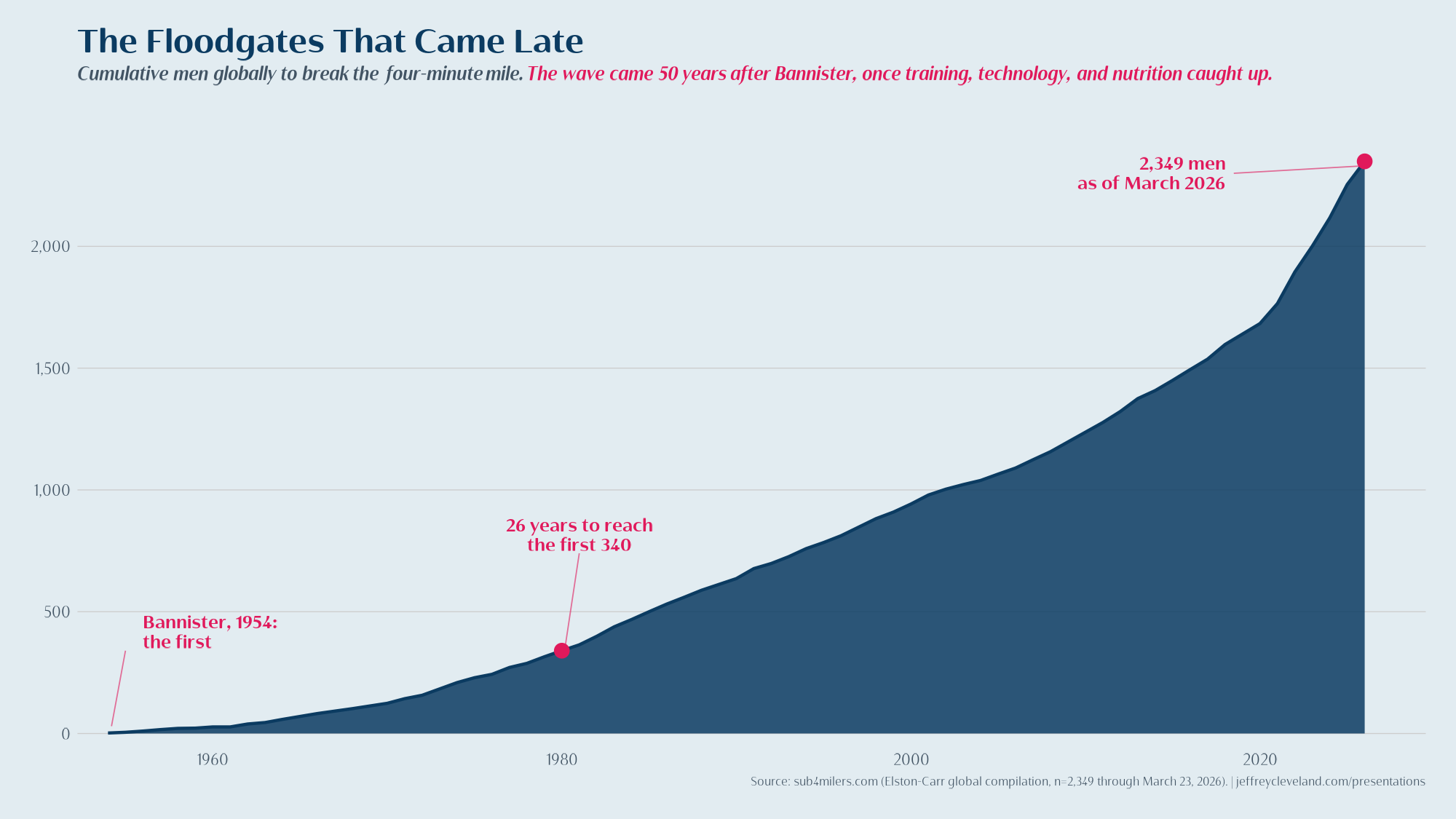
It's more mythology than reality that when Roger Bannister broke the four-minute mile in 1954, the psychological barriers to sub-4 were broken and runners flooded in below the threshold. Instead, it still took decades.
This time, if the drivers of marathon performance are now more scalable (the shoes, the training volume, the fueling), we could quickly see more progress and more runners under the barrier.
View the full presentation (PDF)